Showing posts with label ARPG. Show all posts

Monday, 27 May 2013

Path of Exile: Review


Well Torchlight 2 was the spiritual successor to Diablo 2, now Path of Exile is positioning itself as the homage. Currently the game is in open beta and is scheduled for a soft release soon. Normally I wouldn’t review a beta, however the transition from beta to release will little more than a patch and announcement. Also, Path of Exile is a free-to-play title supported by micro-transactions and the store is already active and ready for you to spend your money, so a review seems fair game to me.

So where does Path of Exile’s gameplay sit in the ARPG marketplace?  Well unfortunately it makes only a few changes distinguish itself, choosing to stick to tried and tested ideas. The combat is very clunky due to a lack of feedback and further handicapped by an odd lag spike every now and again. I often had to wonder if I had genuinely missed an enemy with my swing, or if the game was lagging again. Spells are also seriously lacking in impact. When I summoned a hail of meteors, it seemed to barely inconvenience my foes as if it were merely a light rain. There’s a lack of force and reaction to the damage your character deals.  


Another traditional feature is the mana bar. Once again you’re free to cast your equipped spells as frequently as you want, your only limit being your mana pool. So once you’ve found your favourite single target and area of effect skills, you never need to use any other abilities except for a bit of variety. It really detracts from the action when you can use the same solution in every scenario. Even boss battles were lacklustre and required no tactics to beat. It was simply a test of my character’s equipment.

Thankfully mixing things up is a rather interesting change to potions. Usually you would simply carry giant stacks of health and mana potions around with you to avoid running out at a key moment. Here, potions have only five inventory slots and the potions themselves contain a set number of charges to limit how many uses they have. This makes them a lot more precious during a boss fight, adding a little tension as you have a very limited supply. Outside of boss fights, killing enemies restores potion charges, removing the tedious shopping trips of other titles.


Your character customisation comes from two main areas. Firstly, the skills you use come from gems found as drops in the world. These can be put into equipment sockets to activate them on you skill bar. There’s space on the UI for eight active skills, but you can have more than this inserted into your equipment as there’s a selection of support gems that can boost skills they’re attached to.  Your skill gems also have their own independent experience bars, so the skills you keep socketed in your equipment will become stronger over time as long as you have the base stats required for their next level.

Secondly, the colossal passive skill tree has numerous paths to follow. Each path will give a bonus to one of three base three stats and provided branches into nodes for specific bonuses, such as better spell casting or weapon specialisations. It’s clearly based on the sphere grid from Final Fantasy X and the idea is brilliantly implemented into Path of Exile. It suits the gameplay, allowing you to tailor your character to a play-style you prefer.  Each of the six characters you can choose from has a different starting position on the skill tree, but there’s nothing to stop you from expanding into another character’s area.


The developer’s intentions for Path of Exile are quite clear. Grinding Gear Games have created a dark world, very similar to Diablo 2.  The story follows a similar act structure and even mimics an event in the second act that plunges the world into darkness. On their website they state:

“We're sick of the recent trend towards bright, cartoony RPGs. The art style we chose for Path of Exile is dark, gritty and realistic. Wraeclast is terrifying, and we've tried hard to do it justice.”

And the aesthetic they’ve chosen does live up to that statement. In particular the music does an excellent job of setting the tone of the game, providing a mix of desperation, loneliness and exploration. Although it does have to be said that there’s nothing wrong with the artistic choices made by other titles.


Importantly, the micro-transactions have been carefully designed to avoid players buying power as a major part of the end-game is designed around PvP. Currently the shop sells a range visual customisations which don’t impact the on the gameplay. You can also buy some extra inventory space and character slots which will be useful for players who get heavily into the game. I found the default space to be plenty big enough for the two characters I’ve been playing.


Ultimately, any free-to-play game will be judged on whether or not it’s worth your time. Path of Exile would benefit from improvements to the combat and a better overarching story to drive your adventure forwards. Both of these areas are done better by other games, but since you don’t have to pay for Path of Exile, it can be a good single player game to dip in and out of when you have some spare time. Alternatively, if you’re looking for a co-op game, this is worth checking out as playing as group greatly improves the experience.

Monday, 11 February 2013

Torchlight 2 Review


Runic games are often viewed as the darling developer of ARPGs. The studio was founded from former Blizzard North staff, who practically defined the genre with Diablo and Diablo 2. Torchlight 2 is Runic’s second release; aimed to go head-to-head with Diablo 3, the beast that they helped create and got special thanks for in the credits.

And there is no way of reviewing this game without constantly comparing it to Diablo 3. Each game represents a different design philosophy and yet also fighting to attract the same customers. That being said, it’s important to judge Torchlight 2 on the improvements made over the first title as well.


If you’ve played Torchlight or Diablo, you’ll immediately find a lot of similarities here; too many similarities. I’m beginning to think the Runic staff got stuck in the year 2000, as Torchlight 2 clings to a lot of awkward mechanics which really should have been dropped by now. The actual design improvements could be compared to the small iterative changes between Call of Duty titles.

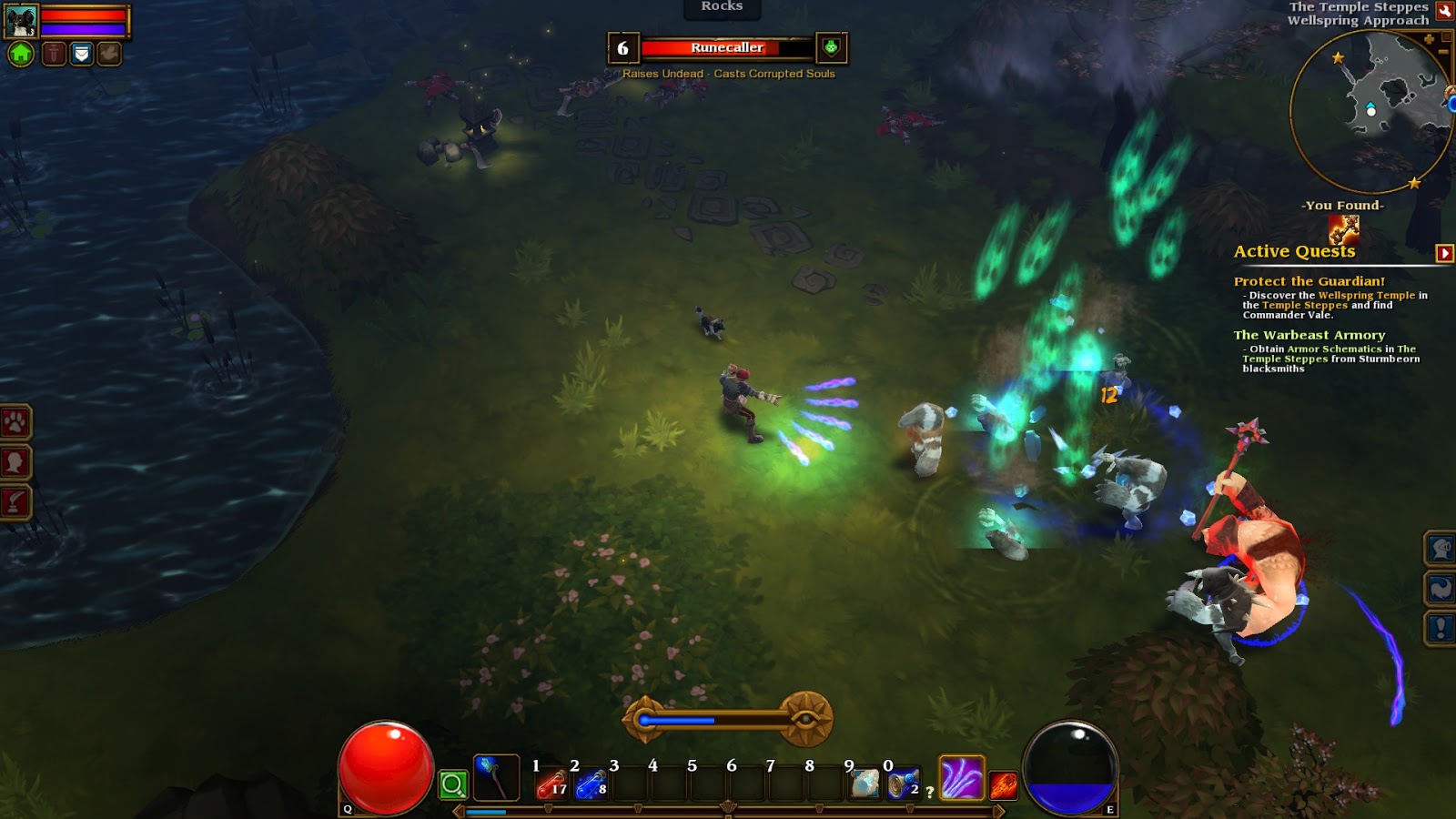
So what should they have axed by now? Well, the way skills and the mana bar interact really needs some improvement. It’s a basic system that dates back to the first Diablo. You earn your skill points and then invest them in abilities to spam to your heart’s content. This leads to one very large problem. You can beat the game with a starting skill of your choice and almost nothing will force you to change. The difficulty setting only served the purpose of being a frustration slider.


And it’s a shame they haven’t moved on from this idea. The skill tree itself has had a great revamp from the first game. In fact it’s not really a tree anymore. You’re allowed to choose from all the skills available when you reach the required level. But the only reason to use the variety being offered is to mix up your gameplay. Passive skills have also had a much needed rework. Instead of being flat percentage bonuses like the first game, they now provide more random or situational bonuses that open up new play-styles when combined with other skills.

However you are still shackled by the old idea of once you’ve made a skill choice, you have to stick with it. If you picked a skill you don’t like with that skill point you just earned; well tough! Runic did make a small concession to this idea with a new NPC. For a pricey amount of gold, you can undo your last three choices, but only the last three! It still baffles me as to why you are still so limited?


The way skills are handled is one of the areas that Diablo 3 really outshines Torchlight 2. Blizzard brought a lot of new ideas to the table which improved the standard gameplay of the genre. Having access to a full set of skills that interact with each other through a character’s resource mechanic added a much needed layer of strategy; especially when it came to boss battles and harder difficulty settings. Also, being able to change decisions and redesign characters opens up a lot of gameplay possibilities and therefore, a great deal more entertainment.

And gameplay is key to ARPG titles. You’ll be spending hours fighting the same enemies or replaying areas on new characters. Skill system issues aside, Torchlight 2 does deliver on this front. It provides are great mix of battling through swarms of enemies to dealing with tougher elite packs.

Spells and physical attacks are given a good feeling of heft and impact through well thought out animations and sound effects. There are a number of options to customise the controls and HUD to your liking so that you’re only presented with the information you want. Spending some time with the options will help you quickly sift your way through the piles of loot you’ll acquire.


The world of Torchlight is expanded only enormously with a range of new environments and locations to explore though. Diablo 3 received a lot of criticism for having a large amount of linear and fixed areas. Torchlight 2 has gone firmly in the opposite direction with plenty of large randomised areas populated with side quests and bonus dungeons to explore.

Surprisingly, the story is probably the weakest element of the game. Considering how low the bar was set by Diablo 3, Runic still managed to limbo under it. The story can be summarised as follows. Bad guy from previous game returns and runs off to cause havoc. Now you must fight your way to him to stop his evil plans, because he’s evil! To get there, you must complete a set of arbitrary quests for random people presented to you in thrilling text boxes! It wasn’t long before I stopped caring about the story and just followed the waypoints on the map. Story has never really been a strong point of ARPGs, but it would be nice to have a plot that makes your actions and adventure more meaningful.


To draw to a conclusion in comparing Diablo 3 and Torchlight 2; I have to say that Diablo 3 takes the award for best gameplay. As I said in my review, it has a core nugget of great gameplay surrounded by crap always online systems. And this is where Torchlight 2 really shines. Instead of forcing always online play for a number of silly reasons, it provides a full choice of offline single player, LAN and online multiplayer.

Runic also designed the game to allow for modding and are actively trying to encourage it as they know what a great asset a modding scene for your game can be. There’s already a massive of selection of mods that have been made for the game. I even found one that allows you to completely redo your skill choices, although that doesn’t mean I’ll let Runic off the hook.


Torchlight 2 also has a number of extra features over Diablo 3 such as character appearance customisation and a pet companion who’ll faithfully blast opponents with any spells you teach it. And your pet can make all your shopping trips for you, although realistically it means you’re simply interacting with your pet’s inventory instead of a shop keeper’s.

Another advantage for Torchlight 2 is price. As a budget title, you should be able to pick it up on the cheap and get a lot of entertainment for you money, whereas Diablo 3 seems to be holding its value better than solid gold bars nearly a year after release. It’s difficult to recommend one over the other as Diablo 3’s always online requirement will be an instant no for many people. If I was forced to choose, I would still pick Diablo 3. But if I hadn’t spent as much time as I already have with the genre, I would pick Torchlight 2. It gives a full ARPG experience for a fraction of the price, so if you don’t enjoy it, you won’t be left with buyer’s remorse.

Monday, 5 November 2012

To Video!

Recently, I've tried my hand at converting the articles I post here on this blog into a video format. Hopefully this is just the beginning with more to follow, enjoy!


Monday, 8 October 2012

Borderlands 2: Even Shootier!


One hundred and eighty, one hundred and eighty one, a critical hit for two hundred and fifty! Bingo! Destruction! Numbers swarm around your screen like a pack of angry maths Bees in Borderlands 2 and it never gets old. Unfortunately the same can’t be said of the NPCs and objectives they give you.

The sequel has built lightly on the foundations of the original. Tweaking the little things and putting a high polish on the funky fusion of FPS and ARPG. Still set on the planet of Pandora. A fresh group of four vault hunters set out on their quest for riches. Utilising the random weapons and explosives you loot along the way to build your arsenal and take down Handsome Jack. And find the real vault of Pandora.


Handsome Jack is the driving force of the game’s narrative. Having tricked the vault hunters in the first game. He’s now using his power as CEO of the Hyperion Corporation to unlock the real vault. Of course he’s not going to get it all his own way. You quickly become a thorn in his side by escaping his trap to kill any new pesky Vault Hunters. Only to discover a planet ravaged by his efforts. You quickly side with the resistance. The Crimson Lance led by Roland, one of the original Vault Hunters and set about taking Jack down.

Currently there’s only a choice of four characters. Salvador the Gunzerker, Maya the Siren, Axton the commando and Zero the assassin. They are all very familiar in theme to the first game’s characters in that their powers are similar. But this is where Borderlands 2 takes its first step forwards. The old powers were very disruptive to the FPS gameplay, which made them feel as if they had very limited use. The new powers synergise with the FPS nature of the game a lot better; either increasing your firepower or providing damaging support.


However it still suffers from a lack of active actions you can perform. Shooting is the majority of the action, with a few on-kill effects and your class power to liven things up. It would have been nice to see some minor powers thrown into the skill trees, giving the player more tools and active abilities to throw at enemies. Admittedly it would be a push for space on a controller, but it would help with replay-ability.

Another mechanical improvement is the introduction of badass ranks. These replace the old gun levelling system which married you tightly to your favourite gun in a literal shotgun wedding. Now you gain badass points for achieving the mass murder of hostile locals in a variety of ways. Get enough points and you can choose from five random character stats. Each provides a small percentage bonus to gun damage, shield capacity, melee damage etc. The bonuses have diminishing returns to discourage min-maxing.


The scenery also received a much needed upgrade. You’re no longer stuck in a desert environment for hours on end. Instead Borderlands 2 starts in a frozen tundra and within the first few hours of gameplay, the story takes you through other settings. Each of the new locations fits well with the cell shaded aesthetic.

The sequel makes further improvements over the first game. Most notable is the ridiculousness of the guns. The designers have clearly had a lot of fun coming up with new designs. The combinations of gun parts the game generates keeps providing moments of looting glee. There’s a lot more variety within the gun types as well, so you have a choice to make between guns. Do I go for the assault rifle that’s masquerading as a mini-gun, or the high power single shot for the tougher enemies? And these moments keep happening throughout the game, although the start is still a case of pick the one with biggest numbers.


If only the same variety could be found in your quests. The vast majority can be categorised into kill this and fetch that. Even worse, quests that make you back track through weaker enemies. After doing a few, I found they served little purpose. They weren’t even entertaining distractions. It was just a check-list of things to do, which exposed the shallowness of the experience. When you notice you’re doing tasks that pad-out the game, the numbers driving the ARPG side of the game take over. Everything you do simply pushes up arbitrary bars until you’re awesome enough to progress.

The problem would be muted if the minor NPCs actually did anything interesting. After a usually dramatic introduction with a funky splash screen, they promptly hand you their first list of chores. If they had back pockets, you’d see a whole wad of them stuffed in there. It would be nice if they actually played an active part in the quests they gave. I’d love to go out in the world and box some locals with Sir Hammerlock, but no; he just stands in Moxxi’s bar not even drinking. Barking fairly polite orders at you over the radio.


Thankfully the major NPCs aren’t quite so unanimated. Every now and then plot allows some of them to join in the fun. Handsome Jack steals the show as the best written character. His lines strike the right balance between the silliness of the world, and atrocious acts of evil. Brilliantly voice acted by Dameon Clarke. You get the sense that every line is delivered with a sadistic smile.

Ultimately Borderlands 2 is still a game that is best enjoyed in multiplayer. Playing solo is ok, but after a while you do get tired of all the enemies shooting you. Having allies makes the combat a lot more satisfying, hiding the monotony of the gameplay. It also allows you to get something out the equipment and skills with team benefits. If only the game was designed to let characters at different levels join the same game. You can always join a friend at low level, but you’ll be able to kill everything with a single melee attack. The game sticks to rigidly to a levelling system. Borderlands 2 is a high quality game, but if the series wants to progress for good to great. Quests and multiplayer need a big overhaul.


Monday, 16 July 2012

Diablo 3: Six Years in Development For...


Diablo 3 wasn't quite the game I was expecting. I found my opinion shifting wildly from thrilled too frustrated. I discussed other APRGs in an earlier entry. Having played biggest release in the genre this year, it deserves a review.


The biggest problem by far is the online requirement. Lag in a single-player game is just ridiculous. Every time I enter the game or alt tab back from the desktop, I'm greeted with a slideshow of my character being mobbed. I quickly learned to park myself in a safe spot, cowering from basic enemies. Of course in multiplayer it's acceptable, that's just the way things are, and you'll have friends to watch your back – hopefully.


But when you get going, the core gameplay is spot on. The controls are near perfect. Aiming abilities, drinking potions, navigating and grabbing loot is satisfyingly easy. You encounter the occasional mis-click where the hit box of the enemy in front is too big, or you collect useless grey items. But these occasions only stand out because they are few and far between.

The skill system is the highlight of the game. It actually innovates within the genre, rather than following the standard skill-tree template. Each class has a set of active and passive skills that are unlocked as you level. At any time, you can have 6 active and 3 passive skills selected. The combinations you pick define your play style. Do you go for a frenzied Barbarian, focusing on high DPS, or equip a shield and hunker down, beating opponents in a war of attrition?

Active skills can be further customised by applying runes. Each rune provides an additional bonus that can simply add extra damage, or change the mechanics entirely. The freedom to change your skills is fantastic. When an ability isn't on cool-down, you can freely swap it, even mid-combat if you're a skilled clicker. This can help overcome the random difficulty spikes.


And the difficulty is really random. To begin with you have to play through on normal, which barely offers a challenge. But in nightmare and beyond, rare and elite enemies become a real problem. This is because they are assigned random bonus abilities, leading to difficult scenarios with my Barbarian. I had to resort to extreme tactics, unable to fight my opponents properly. As an example, a set of enemies that spawn because of the story were given the jailer ability. Faced with three enemies that could root me to the spot and kill me in two mighty swings, I had to change my entire skill set. Equipping ranged abilities and using hit and run tactics until I was victorious 5 minutes later. These groups of enemies are often harder than most boss battles.

Surprisingly Blizzard announced that they were unhappy with the current endgame. The genre hasn't had an endgame with depth so far. The standard formula is to let players explore different class builds and find great loot, pretty simple. But even with the plans to add PvP, Blizzard feels that something is lacking. I think the reason for this is the story combined with too many linear zones.

The story is just ridiculous, it had to be really considering the title and previous games. The voice actors for the main characters do their best to make it credible, but the dialogue is terrible. It's like a West End theatre company putting on a school production. This is compounded by the fact that the secondary characters are the most interesting. Ignore the main characters that contradict themselves and don't recognise obviously evil characters. Instead have a chat with the Blacksmith, your companions or the Jeweller. I found myself actually caring about what they had to say and looking forward to the next chapter in their tale.


Unlike previous games, the over-world design is static. Only the dungeons have randomised layouts. This only highlights to the player the repetitiveness of the game, removing any point in exploring. Why bother when you know what direction the boss is in?

I'm not going to discuss the craziness of the real money auction house in detail; that could have an entry all to itself. It only serves one purpose; making money for Blizzard. That may be a cynical view, but there were simpler options to block illegal item-selling. Just have the gold-based auction house, with very restricted trading between friends. When I last checked the real money auction house, it was plagued with inflation being driven by speculation.

At its heart there's a great game. But it's hampered by unnecessary online systems, and poor design choices that took away replayability. I would recommend it, but only if you find it discounted or have friends for multiplayer. Don't play with random people. It's as bad as you'd expect). Guild Wars 2 is not far from release. Although it's not exactly the same genre, the amount of content and price eclipses Diablo 3.

Monday, 14 May 2012

ARPGs Hoooooooooooooooooo!

For a long time it seemed that Diablo like ARPGs had been forgotten by the game industry, with only Titan Quest and Torchlight wading into the mainstream. Now with the imminent release of Diablo 3, which is about to consume a vast majority of the market and make Blizzard a fresh truckload of cash, I thought I'd take the opportunity to give a shout out to other ARPGs that are in production.


The first contender into the ring is Grim Dawn.


Currently being developed by Create Entertainment, they are marketing the game as the spiritual successor to Titan Quest, citing both technology and staff from it's creator Iron Lore. This is very visible in the videos of the game in action, the satisfying physics engine that sends your opponents flying with every heavy attack. The feature list reads like the game is the next iteration of Titan Quest which was a solid game with interesting dual class possibilities.

The developers are targeting a 2012 alpha release, and it looks like a game that is worth keeping an eye on. The game has a Kickstarter page and has already successfully passed it's funding target, but if you fancy donating in the next few days you can click this link.


Next up is Path of Exile.


Path of Exile is currently in a beta which you can sign up for on the game's website. It is being developed by New Zealand based Grinding Gear Games as a free to play online ARPG, supported by microtransactions which the devs are keen to point out will be aesthetic bonuses only; the best microtransaction policy from the point of view of a gamer.

The most notable feature of the game that sets it apart from the rest of the crowd is it's Final Fantasy X inspired passive skill tree which is gargantuan. It also has some interesting potion mechanics. Your character has various health and mana potions that provide a variety of bonus effects and will recharge over time when consumed. Hopefully it will see a release soon as it has been in development since 2006.


Mixing things up with a portable title, Heroes of Ruin.


Heroes of Ruin is being developed for the 3DS and as far as I know, will be the first Diablo like ARPG to reach a gaming console since Diablo on the PS1 (although the rumours for a console port of Diablo 3 are still doing the rounds). The game is being made by n-Space and is being published by Square Enix.

To stand out from the crowd the game will make use of the 3DS' SpotPass system to download new challenges on a daily basis and StreetPass to provide players with an item trading system. It also touts seamless drop in / drop out 4 person multiplayer. Available for pre-order, it currently looks like it will see a late June release.


Last, but not least, Torchlight 2.


It almost doesn't deserve a place on this list as it is mentioned in almost every discussion about Diablo 3. So I'll keep this super brief! If you haven't played the original it can often be found on discount and is great value for the money. Torchlight 2 is available for pre-order and on Steam you get the original as a bonus that can be gifted if you already own it.